




Note: this repository contains the Java 11 sources of the core modules. A minimal Android app example can be found in the symja-example repository :


Try the full-blown Android or iOS apps:



or help testing the latest Android BETA version or the web demo at matheclipse.org.
Read the Symja Manual 📘 for the description of the Symja language or browse the available functions 📗 . We encourage everyone to participate in our Wiki.
- Installation
- Features
- Applications
- Examples
- Maven Usage
- Getting started
- Github GIT
- Contact
- License
- Science and math library dependencies
The different kinds of installations are described in the Wiki Installation.
Features of the Symja language:
- arbitrary precision integers, rational and complex numbers. Polynomial, list functions and Associations
- differentiation, integration, equation solving, linear algebra, number theory, combinatorial, logic and polynomial functions...
- unified connectivity and interoperability through Symja functions for open source libraries like Hipparchus, Tablesaw, JGraphT, LogicNG, JAS Java Algebra System, apfloat...
- a general purpose Term Rewriting System and Pattern Matching engine
- use human readable math expression strings or the internal abstract syntax tree (AST) representation to code in Java. See the Unit test examples
- two Java servlet based notebook interfaces are available in the library. A Symja server for traditional math input and a MMA server for "Mathematica like syntax" input
- two REPLs are available in the library. A Console for standard math input and a MMAConsole for "Mathematica like syntax" input.
- new "script-functions" can be developed as Packages and loaded into the system
- developers can use Symja interactively in the Java jshell or with a call to to the JSON Web API Server
- the Rubi symbolic integration rules are used to implement the Integrate function, they can be systematically applied to determine the antiderivative of a wide variety of mathematical expressions
- compiling numeric functions with the Janino Java™ compiler
-
Appengine web interface symjaweb.appspot.com - available as open source in this Github repository
-
Android App Calculator N+ on Google play store - available as open source in this Github repository provides an IDE mode to calculate arbitrary Symja expressions.
-
Eclipse EASE extension - use Symja as a REPL in Eclipse with this example Github repository which contains some Symja example scripts.
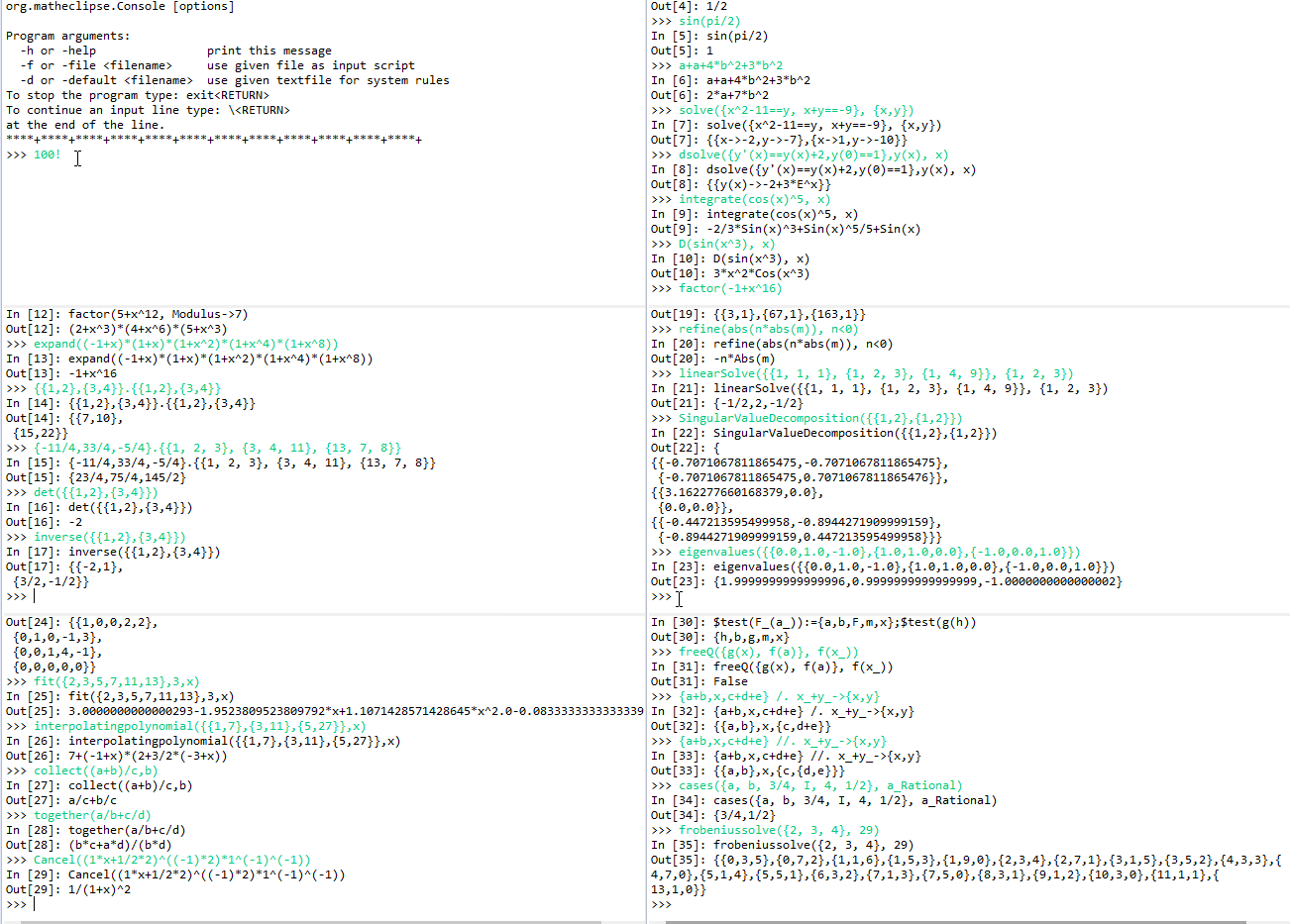

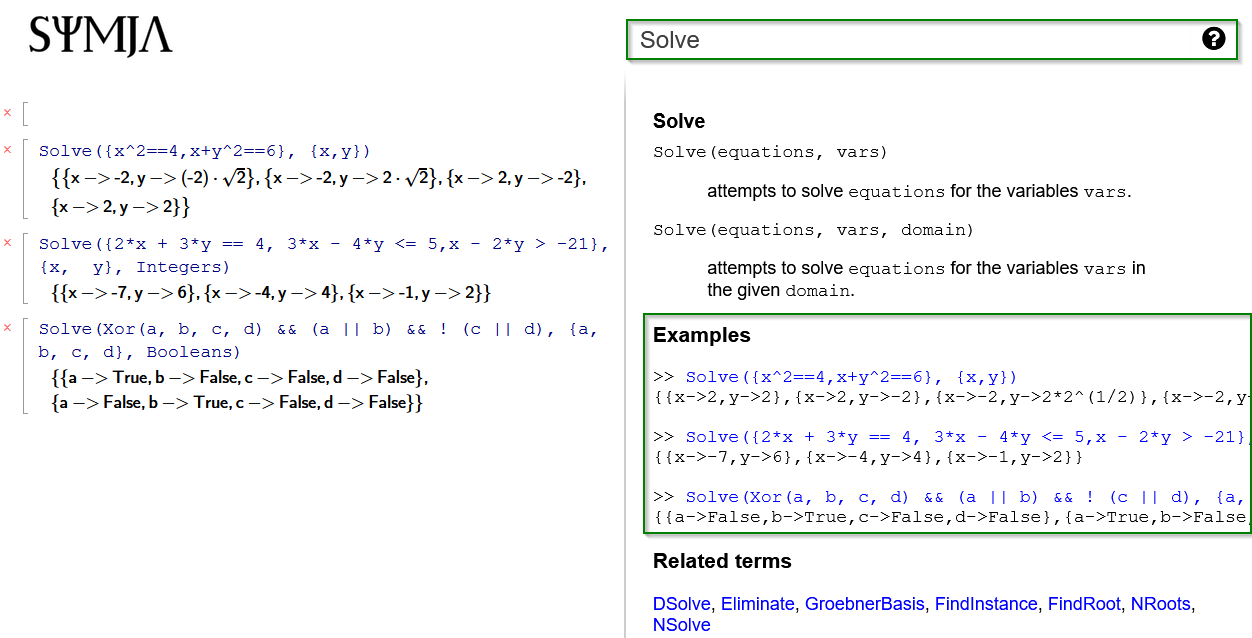

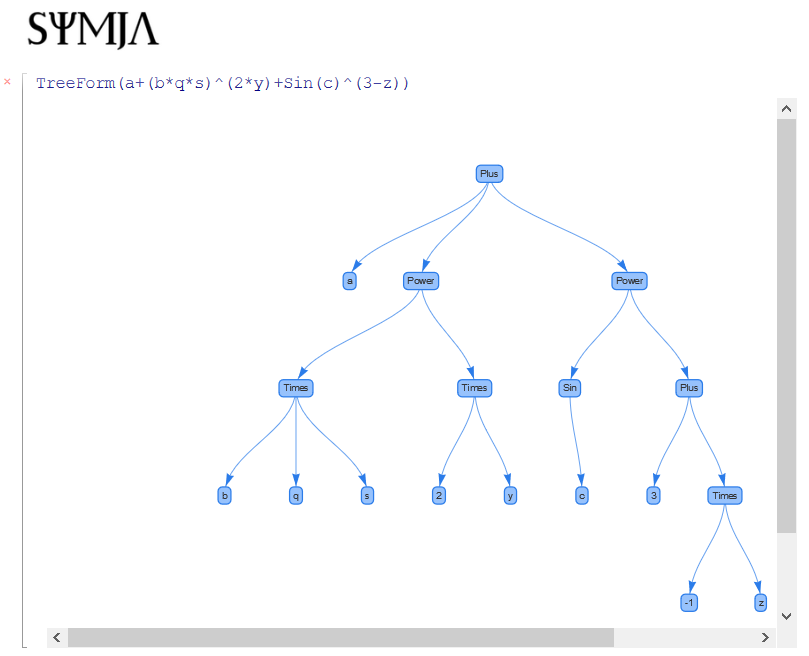
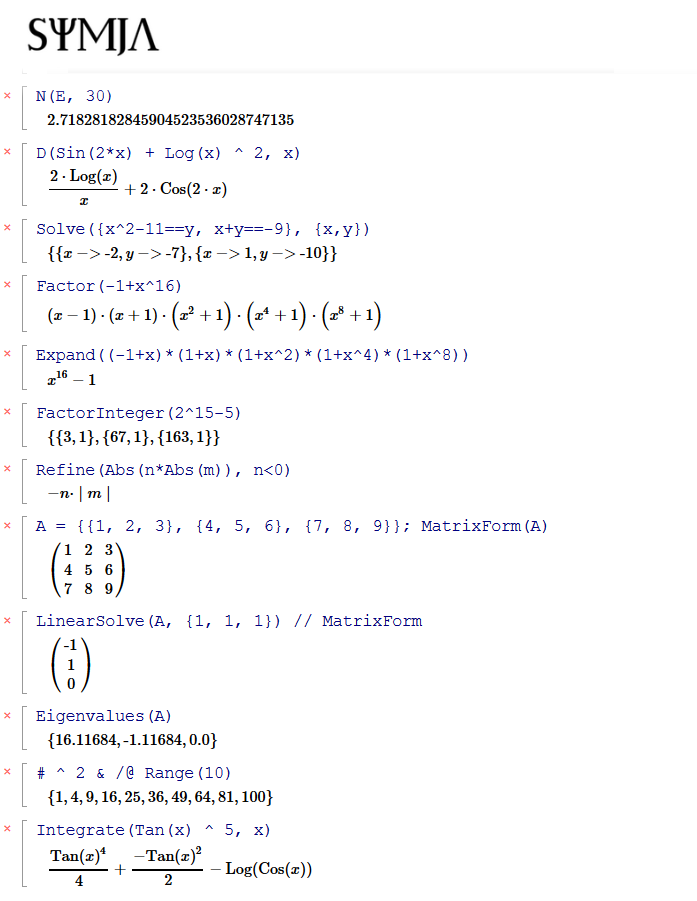
To get an idea of the kinds of expressions Symja handles, see the JUnit tests in this file.
Manipulate(Plot3D(Sin(a * x * y), {x, -1.5, 1.5}, {y, -1.5, 1.5}), {a,1,5})
Plot(Piecewise({{x^2, x < 0}, {x, x >= 0&&x<1},{Cos(x-1), x >= 1}}), {x, -2, 12})
package org.matheclipse.core.examples;

import org.matheclipse.core.eval.ExprEvaluator;
import org.matheclipse.core.expression.F;
import org.matheclipse.core.interfaces.IAST;
import org.matheclipse.core.interfaces.IExpr;
import org.matheclipse.core.interfaces.ISymbol;
import org.matheclipse.parser.client.SyntaxError;
import org.matheclipse.parser.client.math.MathException;

public class Example {
  public static void main(String[] args) {
    try {
      ExprEvaluator util = new ExprEvaluator(false, (short) 100);

      // Convert an expression to the internal Java form:
      // Note: single character identifiers are case sensitive
      // (the "D()" function identifier must be written as upper case
      // character)
      String javaForm = util.toJavaForm("D(sin(x)*cos(x),x)");
      // prints: D(Times(Sin(x),Cos(x)),x)
      System.out.println("Out[1]: " + javaForm.toString());

      // Use the Java form to create an expression with F.* static
      // methods:
      ISymbol x = F.Dummy("x");
      IAST function = F.D(F.Times(F.Sin(x), F.Cos(x)), x);
      IExpr result = util.eval(function);
      // print: Cos(x)^2-Sin(x)^2
      System.out.println("Out[2]: " + result.toString());

      // Note "diff" is an alias for the "D" function
      result = util.eval("diff(sin(x)*cos(x),x)");
      // print: Cos(x)^2-Sin(x)^2
      System.out.println("Out[3]: " + result.toString());

      // evaluate the last result (% or $ans contains "last answer")
      result = util.eval("%+cos(x)^2");
      // print: 2*Cos(x)^2-Sin(x)^2
      System.out.println("Out[4]: " + result.toString());

      // evaluate an Integrate[] expression
      result = util.eval("integrate(sin(x)^5,x)");
      // print: 2/3*Cos(x)^3-1/5*Cos(x)^5-Cos(x)
      System.out.println("Out[5]: " + result.toString());

      // set the value of a variable "a" to 10
      // Note: in server mode the variable name must have a preceding '$'
      // character
      result = util.eval("a=10");
      // print: 10
      System.out.println("Out[6]: " + result.toString());

      // do a calculation with variable "a"
      result = util.eval("a*3+b");
      // print: 30+b
      System.out.println("Out[7]: " + result.toString());

      // Do a calculation in "numeric mode" with the N() function
      // Note: single character identifiers are case sensistive
      // (the "N()" function identifier must be written as upper case
      // character)
      result = util.eval("N(sinh(5))");
      // print: 74.20321057778875
      System.out.println("Out[8]: " + result.toString());

      // define a function with a recursive factorial function definition.
      // Note: fac(0) is the stop condition.
      result = util.eval("fac(x_Integer):=x*fac(x-1);fac(0)=1");
      // now calculate factorial of 10:
      result = util.eval("fac(10)");
      // print: 3628800
      System.out.println("Out[9]: " + result.toString());

      function =
          F.Function(F.Divide(F.Gamma(F.Plus(F.C1, F.Slot1)), F.Gamma(F.Plus(F.C1, F.Slot2))));
      // eval function ( Gamma(1+#1)/Gamma(1+#2) ) & [23,20]
      result = util.evalFunction(function, "23", "20");
      // print: 10626
      System.out.println("Out[10]: " + result.toString());
    } catch (SyntaxError e) {
      // catch Symja parser errors here
      System.out.println(e.getMessage());
    } catch (MathException me) {
      // catch Symja math errors here
      System.out.println(me.getMessage());
    } catch (final Exception ex) {
      System.out.println(ex.getMessage());
    } catch (final StackOverflowError soe) {
      System.out.println(soe.getMessage());
    } catch (final OutOfMemoryError oome) {
      System.out.println(oome.getMessage());
    }
    }
}How to use Maven is described in the Maven wiki page.
First, you'll need a Java Development Kit (JDK) compatible with Java 11 or later.
The Integrated Development Environment (IDE) Eclipse is shipped with a suitable JDK, so you don't have to install a JDK by yourself. Install and open the latest version of the Eclipse development IDE for Java Developers:
a) Fork the Symja repository to use as a starting point.
- Navigate to github.com/axkr/symja_android_library in your browser.
- Click the "Fork" button in the top-right of the page.
- Once your fork is ready, open the new repository's "Settings" by clicking the link in the menu bar on the left.
- Change the repository name to the name of your Library and save your changes.
b) Clone your new repository to your Eclipse workspace.
- Open Eclipse and select the "File -> Import..." menu item.
- Select "Git -> Projects from Git", and click "Next >".
- Select "URI" and click "Next >".
- Enter your repository's clone URL in the "URI" field. The remaining fields in the "Location" and "Connection" groups will get automatically filled in.
- Enter your Github credentials in the "Authentication" group, and click "Next >".
- Select the
masterbranch on the next screen, and click "Next >". - The default settings on the "Local Configuration" screen should work fine, click "Next >".
- Make sure "Import existing projects" is selected, and click "Next >".
- Eclipse should find and select the
symja_android_libraryautomatically, click "Finish".
See this Git version control with Eclipse (EGit) - Tutorial for a general overview.
If you have any questions about using or developing for this project, send me an email!
- the complete Symja system is published under the GNU GENERAL PUBLIC LICENSE Version 3 (GPL) starting with Symja version 2.0.0 parts are published under the Lesser GNU GENERAL PUBLIC LICENSE Version 3 (LGPL).
If you would like to use parts of the system here are some Maven module licenses:
- the maven modules:
parser, external, coreare published under LGPL license. - the maven modules:
gpl, api, ioare published under GPL license.
Here are some of the associated JavaScript licenses:
- the Paul Masson's Math project is published under the MIT license.
- the Paul Masson's MathCell project is published under the MIT license.
- the JSXGraph project is published under the GNU LGPL or MIT license.
- the KaTeX project is published under the MIT license.
The Maven modules below all build on matheclipse-core. A module inherits the dependencies of every module it depends on, so the licenses of matheclipse-core apply everywhere. matheclipse-core itself depends on matheclipse-parser and matheclipse-external; the third-party code vendored inside matheclipse-external is therefore listed together with core.
| Project | Purpose | License |
|---|---|---|
| Hipparchus | linear algebra, ODE solvers, optimization, statistics, FFT, geometry, clustering, curve fitting | Apache License 2.0 |
| apfloat | arbitrary precision arithmetic | MIT License |
| LogicNG | boolean logic, SAT solving | Apache License 2.0 |
| Choco-solver | constraint programming | BSD 3-Clause License |
| AdaptiveQuadrature | adaptive Gauss-Kronrod numerical integration | Apache License 2.0 |
| RoaringBitmap | compressed bitsets | Apache License 2.0 |
| MFL | MATLAB .mat file import and export |
Apache License 2.0 |
| Paguro | persistent (immutable) collections | Apache License 2.0 or EPL 1.0 |
JAS Java Algebra System (vendored in matheclipse-external) |
polynomial arithmetic, factorization, Groebner bases | LGPL; the Java bytecode is dual licensed under Apache 2.0 to allow usage in Android projects |
Cream (vendored in matheclipse-external) |
finite domain constraint solving | LGPL |
Diophantine (vendored in matheclipse-external) |
solving Diophantine equations | MIT License |
SnuggleTeX (vendored in matheclipse-external) |
LaTeX to MathML conversion | BSD License |
fastutil (slim fork vendored in matheclipse-external) |
primitive type collections | Apache License 2.0 |
| Project | Purpose | License |
|---|---|---|
java-math-library (vendored as de.tilman_neumann.jml) |
integer factorization, prime numbers, partitions, modular arithmetic, quadratic residues | GNU GPL v3 |
This module is the reason a distribution containing it has to be published under the GPL.
| Project | Purpose | License |
|---|---|---|
| JGraphT | graph data structures and graph algorithms | EPL 2.0 or LGPL 2.1 |
| Project | Purpose | License |
|---|---|---|
| BoofCV | image processing and computer vision | Apache License 2.0 |
| Hipparchus | numerics and statistics for image operations | Apache License 2.0 |
| JSVG | SVG rendering | MIT License |
| TwelveMonkeys ImageIO | additional raster image formats (JPEG, BMP, TIFF, WebP, PNM) | BSD 3-Clause License |
| Project | Purpose | License |
|---|---|---|
| Orekit | astronomy and space flight dynamics | Apache License 2.0 |
| Hipparchus | linear algebra and geometry | Apache License 2.0 |
| Project | Purpose | License |
|---|---|---|
| BioJava | bioinformatics, sequence alignment, amino acid properties | LGPL 2.1 |
| Project | Purpose | License |
|---|---|---|
| Chemistry Development Kit (CDK) | chemoinformatics, molecular formulas, SMILES/SMARTS, structure diagrams | LGPL 2.1 or later |
| Project | Purpose | License |
|---|---|---|
| ICU4J | Unicode, locale, transliteration and unit data | Unicode License v3 |
| Project | Purpose | License |
|---|---|---|
| Tablesaw (vendored fork) | dataframes and table operations | Apache License 2.0 |
| Apache Arrow | columnar in-memory data format | Apache License 2.0 |
| Apache POI | Excel import and export | Apache License 2.0 |
| fastutil | primitive type collections | Apache License 2.0 |
| RoaringBitmap | compressed bitsets | Apache License 2.0 |
| ICU4J | locale aware parsing and formatting | Unicode License v3 |
| jsoup | HTML table import | MIT License |
| Project | Purpose | License |
|---|---|---|
| Janino | runtime Java compiler | BSD 3-Clause License |
| JavaPoet | Java source code generation | Apache License 2.0 |
| Project | Purpose | License |
|---|---|---|
| apfloat | arbitrary precision arithmetic | MIT License |
This module also depends on matheclipse-gpl and therefore inherits the GPL.
| Project | Purpose | License |
|---|---|---|
| commonmark-java | Markdown parsing and HTML rendering | BSD 2-Clause License |
| Project | Purpose | License |
|---|---|---|
| Discord4J | Discord bot client | LGPL 3.0 |
This module aggregates image, nlp, astro, gpl, bio, chem, graphtheory, compile and dataset and therefore inherits all libraries listed above. In addition it bundles the JavaScript libraries listed in the License section, including KaTeX for math typesetting.